

.jpg)
How Fast-Growing Teams Outgrow Their ERP (and Don’t Know It Yet)
Isn’t growth a good problem to have as a business? Revenue expands, new products launch, additional entities are created, your geographic reach widens, and even the headcount increases. From a board-level perspective, momentum is strong. Yet, many companies discover that growth exposes weaknesses they did not know existed.
Take your time and process that for a second. Does it resonate with your current growth phase?
Mostly, a quieter pattern has emerged. Nothing has failed, and the ERP is online, but the system feels heavier. This is the trap: you can keep hiring and still feel slower every quarter. Work still gets done, but it takes more handoffs, more approvals, more follow-ups, more cleanup, and more exceptions to reach the same outcome. Leaders are ending up spending more time resolving friction than shaping the next phase of expansion.
This is the inflection point where growth begins to outpace the operating assumptions embedded in the ERP environment. If you are growing fast, that pattern is not a capacity issue, but a design issue.
Core message: Growth does not break systems. It reveals where they were never designed to scale.
The Growth Illusion
Most ERP environments are configured around a specific version of the business:
- A certain transaction volume.
- A certain SKU and pricing complexity.
- A certain approval hierarchy.
- A certain number of legal entities.
- A certain level of data governance maturity.
As the business becomes more complex, but the embedded operating design remains static, structural strain arises.
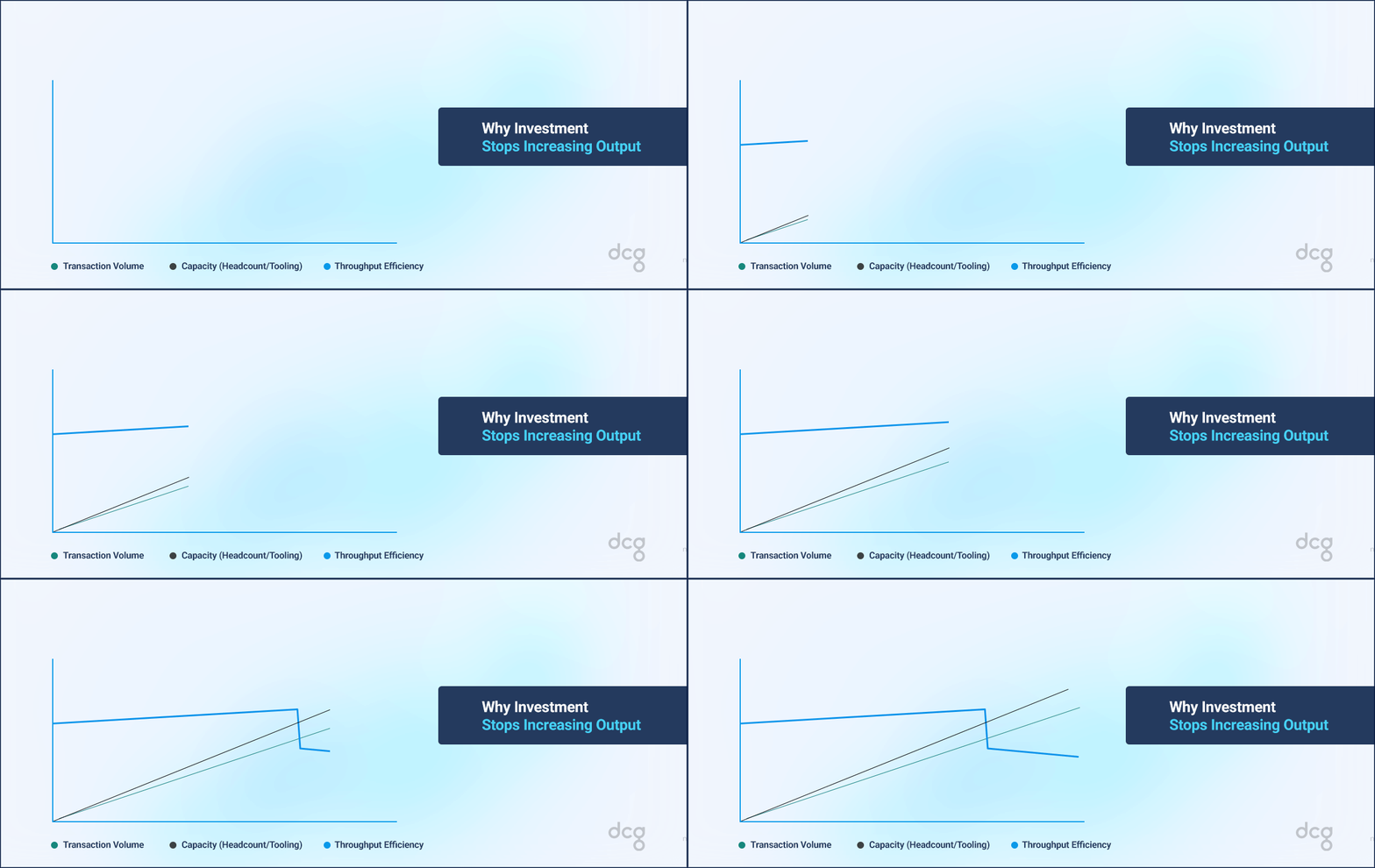
In early-stage expansion, structural strain is readily absorbed. When order volume rises, additional coordinators are hired. When suppliers multiply, accounts payable staff grows. When SKUs expand, planners are added. Throughput increases, reinforcing the belief that the system is scaling successfully.
What is less visible is the rising coordination cost required to sustain that throughput.
- More roles touch each transaction.
- More approvals are inserted to maintain oversight.
- More reconciliation effort is required to preserve financial confidence.
The organization works harder, but not necessarily more efficiently. In this recurring loop, capacity increases create the appearance of scalability while masking workflow misalignment.
The cost of moving a transaction from initiation to completion rises. Additional reviews, escalations, and handoffs are inserted to manage complexity. These changes appear prudent, but they often indicate that workflows and decision rights were designed for a smaller organization.
A useful recognition test is the elasticity of throughput. If incremental hiring yields diminishing output improvement, the constraint is not effort. It is the structural alignment between the operating model and the system design.
Early Warning Signals That Growth Has Surpassed ERP Design
The following patterns typically emerge before visible failure.
Approval Density Increases for Routine Work
Approvals are often added as risk control mechanisms during growth. What begins as governance can evolve into friction. Standard transactions that once flowed with minimal oversight begin to require cross-functional validation. This indicates that the approval model was not designed for the current transaction volume or organizational complexity. Governance structures built for smaller teams do not scale linearly.
Handoff Count Expands
Processes that previously involved two functional roles begin involving four or five. Sales operations, finance, procurement, fulfillment, and IT all touch the same workflow. Each additional handoff increases coordination overhead, latency, and risk of misinterpretation. ERP does not fail in this scenario. It processes what it is given. The strain emerges in the workflow architecture around it.
Exceptions Become Operationally Normal
Exception queues grow. Backlogs persist across cycles. Manual overrides are no longer rare. This is often misinterpreted as a training deficiency or temporary staffing gaps. More often, it reflects business rules that no longer align with current operating variability.
Growth introduces new pricing structures, discount models, sourcing strategies, regulatory requirements, or fulfillment models. If ERP rules were never recalibrated to reflect these realities, exception handling becomes embedded work.
Shadow Systems Re-Emerge
Spreadsheets are reintroduced for forecasting or reconciliation. Inventory trackers operate outside the ERP. Teams build parallel reports to validate system outputs. Shadow systems are not a rejection of ERP. They are a response to misalignment between formal system design and operational needs at scale. When teams require external visibility tools to manage standard work, scale has outpaced structural alignment.
Reporting Becomes a Negotiation
Leadership meetings increasingly focus on reconciling data rather than acting on it. Different functions defend different numbers. This is not necessarily a data quality issue. It often reflects fragmented data ownership and inconsistent rule application across growing entities or business units. The ERP remains operational, but outputs no longer reflect a shared, trusted operating reality.
For teams unsure whether strain reflects early degradation rather than growth expansion, our blog, "How to Detect Early Warning Signs of ERP Failure," provides a stability-focused perspective.
Diagnostic Table: What You See vs What It Usually Means
The following table can be used to assess whether growth strain is structural rather than temporary.
This table is a recognition instrument. If multiple areas show persistent misalignment, the issue is structural.
Why ERP Feels Like the Problem (But Usually Isn’t the Root Cause)
When leaders feel growth strain, ERP becomes the natural villain:
- “The system is slow.”
- “It can’t handle our volume.”
- “It’s missing features.”
- “We need a new platform.”
Sometimes that’s true. Often, it is incomplete. ERP does not just run transactions. It encodes assumptions:
- how master data is defined and governed
- which team owns which decision point
- where exceptions should be handled
- what “done” means in a process
- what qualifies as revenue, inventory, cost, and margin
What changes with growth (even if the software did not)
- The business model expands: new channels, new geographies, new product mixes
- Variability increases: more edge cases, more timing differences, more fulfillment patterns
- Decision velocity becomes critical: delays compound across a larger pipeline
- Coordination cost rises: more teams touch the same transaction
If the operating model does not evolve, ERP becomes a mirror. It reflects the misalignment back at you, at scale, every day. This is why “ERP modernization” can fail when it starts as a technology decision instead of a design decision. The platform can amplify discipline, but it cannot substitute for it.
The Business Cost of Waiting
Structural strain does not immediately manifest as catastrophic failure. Revenue can continue to rise while inefficiencies compound. The cost is divided into four primary areas.
Waiting limits your recovery options drastically. The longer structural misalignment persists, the more embedded the workarounds become. Eventually, corrective action requires broader stabilization rather than targeted adjustment.
How Leaders Regain Control (Without Jumping to Technology Decisions)
The instinct under growth strain is to pursue visible change, replace the ERP, add new modules, and introduce automation. Effective leaders instead begin with diagnostic clarity.
Leaders should examine:
- Whether approval routing reflects current risk tolerance
- Whether decision rights are explicit across expanded entities
- Whether exception patterns correlate with new growth dimensions
- Whether data governance matured proportionally to complexity
- Whether workflows reflect the current operating scale
Get a quick gut check by leveraging our ERP Health Assessment.
Moving Forward: If Growth Is Straining ERP, Do Not Start With Tools
Growth is still a good problem to have. But unmanaged growth exposes structural debt faster than most leadership teams expect. If this analysis feels familiar, the next step is not a procurement discussion or system replacement. It is understanding where growth has surpassed embedded design assumptions.
Growth is earned. Scalability is designed. The earlier leaders recognize that difference, the more controlled their scaling decisions will be.

.png)