

Breaking the Microsoft Support Cycle Education Guide : A Guide for K-12 and Higher Ed IT and Procurement Leaders
The move to spend-linked pricing is already playing out at institutions. The Open University in the United Kingdom entered into a Microsoft Unified Support contract in September 2024., shortly after the shortly after the July 2024 deadline took effect.
A spend-linked support fee behaves differently for a school district than it does for a corporation. A commercial enterprise can often absorb a support cost increase inside a broader technology budget that flexes with revenue. A public institution generally cannot. Most K-12 and higher ed technology budgets are set months in advance, tied to a fiscal year, and subject to board or trustee approval before a dollar moves.
Unified Support’s pricing model compounds that mismatch. The fee is calculated against total Microsoft spend rather than support consumption. As a result, the cost rises automatically every time an institution expands its Microsoft 365 licensing, adds Azure workloads, or adopts a new Microsoft product. The increase happens regardless of whether the institution’s support needs have grown at all.
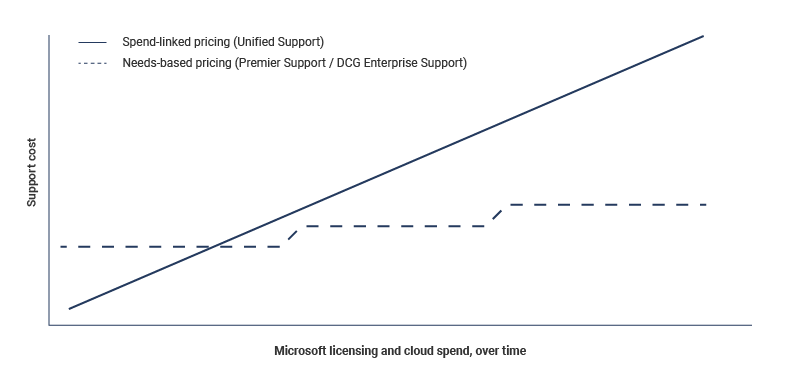
A district funding a new classroom technology rollout, or a university expanding its cloud footprint for research computing, sees its support bill rise even when support ticket volume stays flat.
A non-profit association for higher education IT, has spent more than two decades benchmarking how institutions budget for technology. Its data consistently shows central IT spending occupying a small, closely watched share of an institution’s total budget. That small, fixed share is one reason for an unplanned increase in a single line item like Unified Support tends to draw board-level attention quickly.
For institutions with small, generalist IT teams, the practical effect is sharper. A department with limited staff and no dedicated escalation specialist absorbs the same spend-linked fee structure as a large enterprise with a dedicated vendor management function. That department typically lacks the internal resources to negotiate or benchmark the fee the way a larger organization can.
Public accountability adds a further layer. A private company can explain a cost increase in a single internal board meeting. For a public institution, that same increase becomes a line item that a superintendent or CIO may need to defend to trustees, a school board, or a state oversight body. Often, there is no ready explanation of what has changed or why.
For procurement and sourcing teams, the concern is structural rather than just budgetary. A Unified Support contract locks an institution into a fixed multi-year commitment, with little room to right-size scope or reclaim unused support capacity mid-term. Pricing terms are not always transparent at renewal, which makes the fee difficult to benchmark against peer institutions or negotiate before signing.
The Shift Toward Partner-Led Support
Education institutions facing this cost structure have alternatives. A growing number of enterprises and public institutions are moving toward partner-led support models that price against actual support needs instead of total technology spend.
Partner-led support restructures the relationship in a few concrete ways. Institutions get direct access to senior engineers from the first interaction rather than a tiered escalation queue, pricing aligned to the support they actually use, and governance built around accountability rather than entitlement breadth. We have written in more detail about this broader shift away from Unified Support, which applies to education institutions facing the same underlying pricing structure.
The mechanics of partner-led, needs-based pricing track closely with the Premier Support model institutions relied on for years, before the July 2024 change moved them onto Unified Support’s spend-linked structure. For education specifically, that overlap makes the shift feel familiar.
DCG’s Enterprise Support Framework, Applied to Education
DCG Enterprise Support applies the same engineering-led framework used across DCG’s enterprise client base to the specific constraints of education institutions.
Pricing is built around an institution’s actual support needs, structured closer to the hours-based approach institutions used under Premier Support than to a fee tied to total Microsoft spend. That structure gives a business office a number it can plan around a year in advance, rather than a fee that moves with every licensing decision the IT department makes.
For procurement and sourcing teams, engagement terms are structured to flex with the institution rather than lock it in. Scope can be right-sized at renewal as an institution’s needs change, rather than carried forward as a fixed multi-year commitment regardless of fit.
Every engagement includes direct access to senior engineers from the first support interaction. Case continuity across incidents means a district or university does not re-explain its environment to a new contact each time an issue escalates. As a single point of accountability, DCG’s assigned Customer Success Account Manager tracks each case and each renewal cycle.
Small, generalist IT teams benefit disproportionately from direct engineering access. A department of two or three IT generalists supporting an entire district gets the same senior-engineer access as a much larger organization, without needing to build senior engineering expertise in-house.
Public accountability shapes DCG’s reporting as well. Education leaders often need to explain support spending to a board or trustees. DCG structures cost reporting to be transparent and defensible on its own, so a superintendent or CIO does not need to reconstruct the explanation from a vendor's invoice.
Real-World Impact
DCG has documented measurable outcomes from organizations that made this transition.
Cambia Health Solutions, a nonprofit healthcare organization serving more than 3.6 million members, experienced delayed communication, missed SLAs, and escalation bottlenecks with its previous Microsoft support before working with DCG. Early in the engagement, DCG worked with Cambia to map priorities across Exchange Online, Azure AD, and Microsoft Teams, organizing scope so problems could be caught early. When a Bing Chat with Copilot rollout created unexpected legal exposure, DCG escalated the issue to Microsoft as a Severity 1 and resolved it within 24 hours. Cambia has since renewed its partnership with DCG, citing restored confidence in its support operations.
Every organization’s environment differs, and results vary by scope and starting point. Even so, the pattern DCG has observed across sectors is consistent: needs-based pricing and direct engineering access tend to reduce both the frequency of high-severity incidents and the total cost of support. Problems get addressed before they escalate, rather than resolved afterward through a tiered process.
Next Steps: An Evaluation Checklist Before Your Next Renewal

.png)