

Microsoft Spend as a Percent of IT Budget
Microsoft's commercial model has shifted more in the last twelve months than in the previous decade. If your IT budget still assumes Enterprise Agreement pricing behaves the way it did in 2023, the gap between what you planned for and what you're actually billed is about to widen. Finance is usually the last to find out.
This piece walks through where Microsoft licensing costs stand today, gives you a working benchmark for what a normal share of a 1,000-seat IT budget looks like, and lays out the specific forces pushing that number higher in 2026.
Why It Matters
Three structural changes have landed in quick succession, and each one compounds the others.
EA discount tiers are gone. As of November 1, 2025, Microsoft eliminated the programmatic discount levels B, C, and D that Enterprise Agreement customers relied on for volume pricing. Every organization now starts renewal negotiations at Level A, the list price, regardless of size. Organizations that previously carried a 6% to 12% volume discount are absorbing that removal in full, according to Microsoft's own licensing guidance and independent analysis from Directions on Microsoft.
The EA itself is narrowing. Starting in March 2026, Microsoft began migrating EA customers on Azure consumption plans toward the Microsoft Customer Agreement for Enterprise, known as MCA-E, according to Microsoft's own transition guidance on Microsoft Learn. In practice, roughly 2,400 seats has become the informal floor for keeping a traditional EA. Organizations below that threshold are typically steered toward CSP or MCA-E, both of which trade the EA's three-year price lock for more variable, term-based pricing.
List prices are climbing on top of the discount removal. Microsoft confirmed in its official pricing FAQ that Microsoft 365 E3 and E5 commercial list prices increase on July 1, 2026. E3 moves from $36 to $39 per user per month, and E5 moves from $57 to $60. A wider set of Business, Frontline, and standalone SKUs are affected too. Existing customers keep their current pricing only until their next renewal after that date.
Info-Tech Research Group's Microsoft Year-End 2026 report describes what happens when these three changes move together: discount tier resets, list price increases, and Unified Support fees, which scale as a percentage of total licensing spend, land inside the same renewal cycle and compound rather than arrive as isolated line items.
The Real Number Is Bigger Than the Headline
Microsoft's July 2026 price increase is published as 5% to 8% for most Microsoft 365 SKUs. That's not the number large enterprises will actually feel. Here's a simplified version of the math: an organization that lost an average 9% volume discount (roughly what a former Level C customer had) combined with a 6% price increase is looking at close to 15% higher costs before a single seat or SKU gets added.
Licensing consultancy SAMexpert breaks down exactly where that gap comes from for a 25,000-user Microsoft 365 E5 organization that previously held Level D pricing, a 12% discount. The July price increase alone adds about $900,000 a year. The lost discount adds roughly $2 million more. Combined, that's close to $3 million in additional annual cost: an increase of about 20%, most of it invisible in the 5.3% headline figure. Across organizations losing Level B through D discounts, SAMexpert puts the realistic, combined range at 15% to 23%.
Bring that 15% to 23% range into the next budget conversation. The published 5% to 8% headline undercounts the real impact.
The 1,000-Seat Benchmark
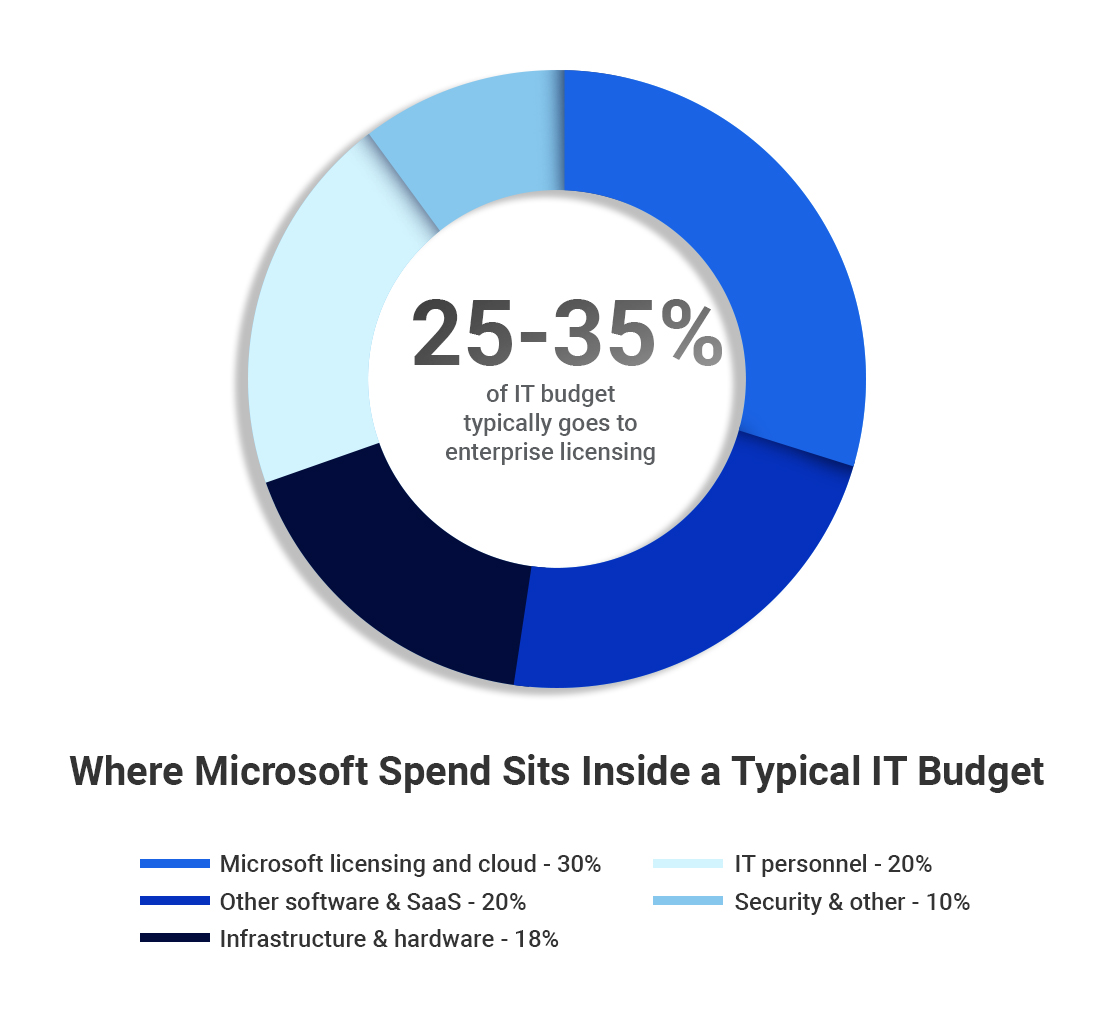
Most finance teams don't have a clean way to answer a simple question: is our Microsoft spend normal, or are we overpaying? A useful starting point is looking at Microsoft licensing as a share of total IT budget for a representative organization, rather than comparing raw dollar figures across companies of different sizes.
Enterprise software licensing (Microsoft, alongside platforms like SAP and Oracle) typically represents 25% to 35% of total IT budget for a mid-market or enterprise organization, according to IT spend benchmarking research. Where a given organization lands inside that range depends on the licensing model in place, how aggressively the environment has been optimized, and how much of the Microsoft environment has shifted to consumption-based Azure spend versus fixed seat licensing.
What Drives Microsoft Costs
Licensing model. EA, CSP, and MCA-E carry meaningfully different cost and flexibility trade-offs. The EA's price lock has weakened without its discount structure. CSP and MCA-E offer more flexible terms but expose organizations to more frequent price movement.
Annual price increases. Between November 2025 discount removal and the July 2026 list price increase, Microsoft's list pricing is moving on two separate tracks inside twelve months. That's an unusually fast pace, even for Microsoft's regular pricing cadence.
User growth. Seat count is the most direct lever on total license cost. Under an EA, added seats are typically reconciled through an annual true-up rather than priced individually as they're added, a mechanism many finance teams don't fully model until renewal.
Additional Microsoft services. Security Copilot, expanded Intune capabilities, and other add-ons are increasingly bundled into core suites, part of what's driving the July 2026 increase. That changes the calculus for organizations already paying for those capabilities separately or not using them yet.
Support and maintenance costs. Microsoft Unified Support is priced as a percentage of total Microsoft spend, commonly cited in the 6% to 12% range depending on tier. The support line grows automatically whenever licensing or Azure consumption grows, whether or not actual support usage changes at all.
A related, less visible driver sits inside Azure. Consumption Commitments, known as MACC, require organizations to commit to a spending floor in exchange for discounts. Missing that floor at term end can mean paying for consumption that never happened.
Questions to Ask Before Your Next Renewal
- Do you know what percentage of your IT budget currently goes to Microsoft: licensing, Azure, and support combined?
- Has that percentage increased over the past two years, and can you explain why?
- Are you still on the most cost-effective licensing model for your seat count and consumption pattern?
- Is there a clear owner accountable for catching optimization opportunities before your next renewal, rather than after?
The Bottom Line
None of this is hypothetical. It's already reflected in Microsoft's own published pricing and licensing guidance. The organizations that come out ahead at their next renewal are the ones benchmarking their current spend now, rather than waiting for the renewal notice to start asking questions.
Compare the budget impact of EA vs. CSP

.png)