

Why You're Paying for Engineers You'll Never Meet
A procurement look at what your Unified Support premium buys, and how to verify it before your next renewal.
The Decision That Made Sense
Centralizing enterprise support under a single Microsoft agreement is a defensible call. One contract instead of a patchwork of vendors. One point of accountability on paper. Coverage that follows the environment across Azure, Microsoft 365, Dynamics 365, and on-premises workloads without a separate negotiation for each piece. For a procurement team already managing dozens of vendor relationships, that consolidation is a genuine risk reducer.
The premium attached to that consolidation carries an assumption most buying teams never write down: paying more buys access to a specific caliber of Microsoft engineering talent, the caliber implied by the brand and the price. That assumption is fair, but it deserves examination
What Procurement Assumes It's Buying
Microsoft prices Unified Enterprise Support as a percentage of an organization’s trailing twelve months of Microsoft spend. Microsoft’s own program materials call this base the “Product Spend.” Rates are graduated and start at 8 to 10 percent, applied across Azure consumption, Microsoft 365 and other online services, and on-premises licensing with Software Assurance. Microsoft’s own published example shows a customer with $6 million in annual Azure spending paying 10 percent on the first $1.8 million and 7 percent on the remaining $4.2 million.
At face value, bundling support into one predictable percentage is a reasonable way to price a service that has to flex with a customer's size. Consumption, licensing, and support are three-line items that procurement, IT, and finance usually review on separate lines. In practice, they are not independent of one another. Cloud usage grows because the business is growing. Licensing grows because seats grow. Support looks like a flat percentage add-on. But the support line is really a percentage riding on top of the other two. A support fee can climb in a year when ticket volume falls simply because Azure or Copilot consumption grew.
Here's that graduated-rate math extended across three years of moderate spend growth:
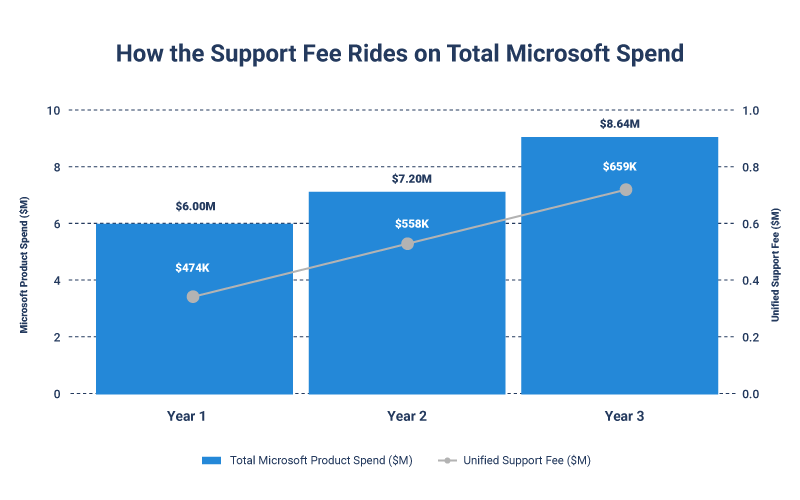
That isn't hypothetical this year. Microsoft's own quarterly disclosures show Azure revenue growing roughly 40 percent year over year, with Copilot adoption climbing toward four in ten Microsoft 365 enterprise customers. Any organization scaling AI capability at that pace should expect its Product Spend base, and its support fee, to climb without procurement approving an increase.
The price paid and the engineering caliber behind any single ticket are not contractually linked to one another. That gap is what the rest of this piece works through.
How Case Routing Actually Works
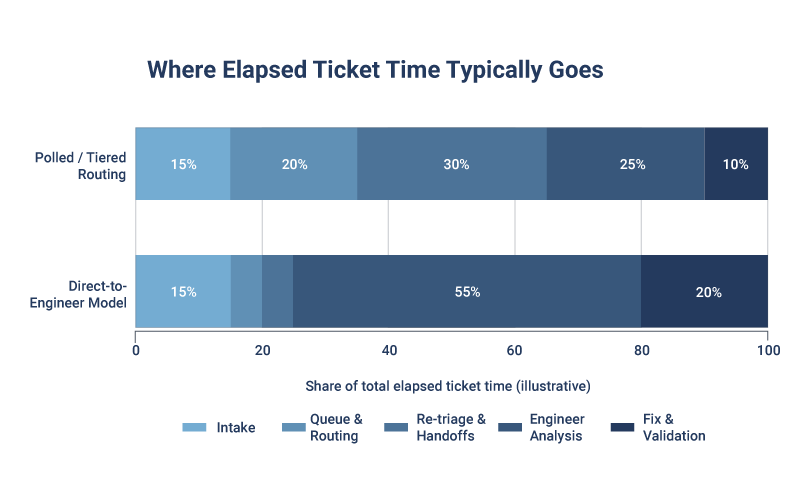
Unified Support, like most support offerings built to scale across thousands of enterprise customers, routes cases through a tiered, pooled model. A ticket typically moves through several stages before the engineer with the deepest relevant expertise gets involved:
- Intake: logs, environment context, timestamps, and reproduction steps are gathered.
- Queueing and routing: the case is assigned to a product area and a severity lane.
- Re-triage and handoffs: validation repeats each time ownership changes hands.
- Engineer analysis: deep diagnosis begins once the right specialist is engaged.
- Fix and validation: remediation is implemented, tested, and closed.
Tiered triage exists for a defensible operational reason. It lets a support organization allocate a finite pool of specialized engineers across an enormous, varied customer base without routing every case directly to a senior specialist regardless of complexity.
The trade-off shows up in the day-to-day experience of any one enterprise. Microsoft defines “initial response time” as the moment a support engineer first contacts the customer. That milestone is explicitly different from time to resolution, and it carries no built-in guarantee that the responding engineer is the workload specialist a given incident actually needs. A fast acknowledgment and a slow resolution can live inside the same ticket.
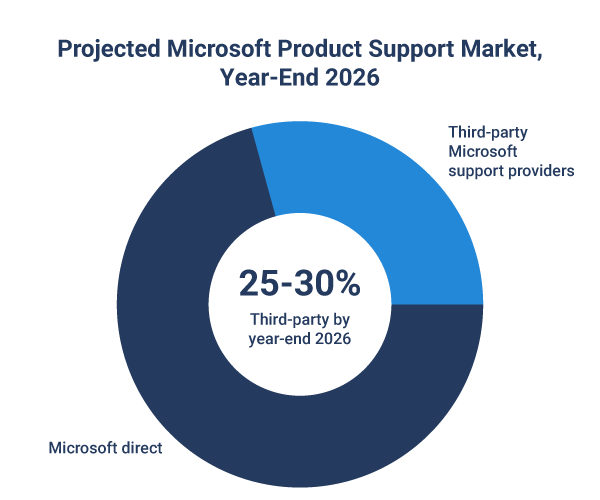
This gap has grown large enough to support an entire market response. Gartner projects that third-party providers of Microsoft support will hold 25 to 30 percent share of the Microsoft product support market by year-end 2026. That shift is happening because enough procurement and IT teams independently concluded that pooled-triage support, whatever its operational logic, was not giving them a way to verify who was actually working their cases.
The Verification Gap
A Unified Support invoice shows a percentage applied to a spend base. It does not show which tier of engineer opened, worked, or closed any given case. There is no line-item connecting the premium paid to the seniority of the person handling a specific ticket. There is no standard report that lets a renewal team ask a simple question: for the cases raised this year, who worked them, and did their level match what the quote implied.
That absence is easy to miss in a renewal deck, because the entitlement description reads as comprehensive: 24/7 coverage, escalation management, advisory services, training. Coverage describes what is included in the contract. Access describes who actually shows up on a case. A renewal can satisfy the first description in full detail while leaving the second one unanswered.
Trusting a major, well-established vendor at renewal time is a reasonable starting posture. A few consequences still tend to follow from the visibility gap on top of that trust. Renewal conversations lean on brand trust rather than evidence of delivered value, because the evidence was never captured in a form procurement could review. Spend-driven budget increases can look, from a distance, like they are buying more engineering depth, when they may simply be tracking a larger Azure or Copilot bill. The honest answer to “did we get what we paid for” often comes down to a shrug, because the contract was never structured to produce a different answer.
Why Named, Consistent Access Reduces Risk
By design, a pooled staffing model cannot offer the same continuity as a named point of contact. Every handoff between engineers resets institutional knowledge: the new owner asks for the same timestamps, the same logs, and the same environment context the previous owner already had. That repeated validation cycle is a structural cost of rotating case ownership across a large, shared team, independent of how skilled any individual engineer is.
The stakes attached to that cost are measurable. ITIC's most recent downtime benchmarking found that a single hour of downtime now costs more than $300,000 for over 90 percent of mid-size and large enterprises. Additionally, IDC's Fortune 1000 research puts critical application failure at $500,000 to $1 million per hour. Every additional re-triage cycle, every day a ticket sits without a clear owner, gets measured against numbers in that range. Consistent engineering access is one of the more direct levers available for shortening that exposure window.
Named, consistent access also changes what procurement, IT, and finance can each independently verify. When the same engineer, or a small, known team, owns an account over time, a renewal team can ask concrete questions: how many cases this person handled, what the median time to engagement looked like, and whether the same issue recurred.
A Different Starting Premise
There's a different way to design a support model: build it around engineering engagement rather than Microsoft consumption. Cost ties to the work actually delivered and to a named point of engagement, not to a percentage of whatever an organization happens to spend with Microsoft in a given year. That's the premise behind DCG's Enterprise Support.
Under that premise, access comes from a dedicated engineering contact assigned to the account from the first case, consistent enough that procurement, IT, and finance can each confirm who is working their tickets and how that time is being spent. Reporting reflects hours, case categories, and outcomes rather than a spend percentage. Escalation to Microsoft is preserved for cases that genuinely require it, rather than serving as the default first stop for everything.
A model built for breadth of entitlement across a huge customer base will tend to trade continuity for scale. This one makes the opposite trade on purpose, favoring accountability and continuity instead.
The Question Every Renewal Team Should Ask
Before the next renewal meeting, one question cuts through most of the rest: can you name the engineer who worked on the last three critical cases, and would you recognize that name if it came up again? If the honest answer is no, that's a fairly direct measurement of whether current support spend maps to verified access, or to an assumption about access that has never actually been tested, regardless of how diligent the team has been.
Next: A Renewal Checklist and a Cost Breakdown
Assess the last renewal invoice against actual case history before the next one arrives. The gap between the two is usually where the real budget conversation is hiding. Explore Five Questions to Ask Before Your Unified Renewal for a starting checklist to bring into that review and look at Support Cost Breakdown: The Real Math Behind Your Microsoft Invoice for a closer look at how the spend-based formula behaves across a multi-year contract.
Or Talk to a DCG engineering lead and get a straight answer on what your next renewal would buy in engineering time.

.png)