


5 Signs Your ERP Isn’t Broken – It’s Just Not Aligned with Finance
If you’re questioning whether your ERP system is still serving your business, you’ve come to the right place. When planning next steps, a tailored approach makes all the difference.
When it comes to ERP, one-size-fits-all usually means inflated costs and low returns. Too often, we see finance teams locked in a cycle of patching outdated ERP systems and pouring budgets into maintenance rather than digital excellence. This results in slow, inaccurate, or incomplete reporting that hinders decision-making.
Outdated Systems Are Holding Finance Back
Outdated systems drain resources and expose organizations to unnecessary risk. You can’t go back. While systems offer automated updates and built-in compliance to mitigate these risks, a poorly planned implementation can still lead to costly setbacks.
When faced with messy data and unreliable reports, it’s easy to feel like your company has let the team down. Yet for many finance leaders, the system itself isn’t broken; it’s just not aligned to reliable data sources.
Let’s break down the real ERP reporting problems finance teams are facing and how our SPEAR framework offers a strategic realignment, not a costly rebuild. With our human-first and data-led approach, we find where your system is failing to meet your organization’s needs and help resolve post-ERP go-live issues.
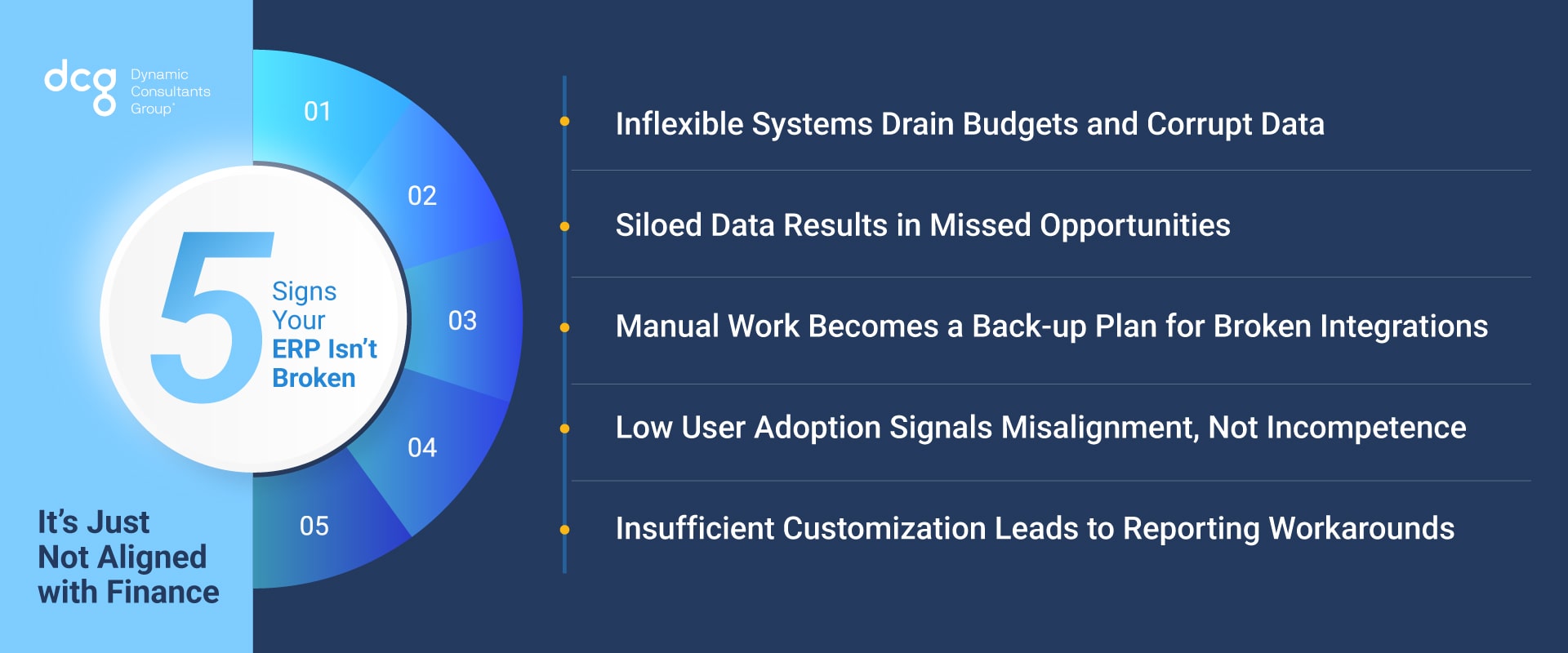
1. Inflexible Systems Drain Budgets and Corrupt Data
When reporting lags, it’s usually not a user issue - it's a system planning issue. Decoding the “why” of ERP design before the “how” is critical to steer clear of costly failures and align finance to your system.
If your ERP is old or rarely updated, it’s likely missing the security, compatibility, and return-on-investment required to drive real transformation.
Outdated systems create vulnerabilities that impact data and processes that finance alone can’t fix. According to a McKinsey study, adopting digital and predictive maintenance tools can cut costs by 15–30% for data-heavy organizations still relying on outdated systems.
2. Siloed Data Results in Missed Opportunities
ERP reporting problems often come down to delayed or inaccessible data. When reporting is delayed, so is the decision-making. Finance departments can’t afford to work in silos and operate on inaccurate numbers.
The Hong Kong Productivity Council’s (HKPC) November 2024 report highlights the importance of combating data silos across Asia’s major industrial hubs. Amidst rapidly evolving industries, true digital readiness starts with unifying core business functions.
We help you unify your business with live dashboards that enable finance teams to detect trends and act fast. Without reliable and timely data, reporting can’t support forecasting, planning, or even basic performance reviews. Starving finance functions of access to actionable data isn’t just a costly inconvenience, but a strategic risk.
3. Manual Work Becomes a Back-up Plan for Broken Integrations
Disconnected financial applications lead to data duplication, manual reconciliations, and constant back-and-forth between teams. Integrations are intended to streamline these workflows, not create new ones. Post implementation, many organizations still spend added time on manual entry due to “quick fix” ERP integrations.
If your ERP doesn’t connect cleanly with other business tools to drive operational agility, your finance team ends up buried in spreadsheets.
One of the strategic goals of ERP for finance is to reduce manual work and free time for high-value analysis. If your finance is still juggling bulk spreadsheets to make the ERP system useful, your system isn't in-sync; it’s fragmented and requires strategic realignment.
With modern ERP systems, businesses can unify this data across systems without time-consuming duplication. At DCG, we help you harness these capabilities to connect more data sources, unlock greater flexibility, and deliver insights that move with your business.
4. Low User Adoption Signals Misalignment, Not Incompetence
Low productivity isn’t always a training issue. It often reflects a system that wasn’t built with its users in mind. Without strong user adoption, organizations lose momentum and risk falling behind competitors. Up to 50% of ROI can vanish quickly jeopardizing the success of digital transformation.
We’ve also seen finance teams avoid the system entirely. This is not because they don’t care, but because the system isn’t built for their unique requirements. A clunky interface or lack of support kills adoption, but there is a way to regain your team’s trust and bring them back into the system.
The issue likely lies in how the ERP was configured, not in a team’s capability. At DCG, we help you reduce risks by improving trust in your data and designing live dashboards that give finance and operations current insights to spot trends, forecast accurately, and take decisive action. While modern ERPs come with guided workflows like Microsoft’s Copilot, true success lies in how you implement and adapt these tools to your business. That’s where we come in.
5. Insufficient Customization Leads to Reporting Workarounds
You shouldn’t have to fight your ERP to get answers. Whether it’s rigid report templates or inaccessible metrics, lack of customization forces teams into workaround mode. That is a risky place to be when leadership is depending on prompt, exact data to make decisions.
At DCG, we focus on making your ERP work for you. This means simplifying access to the insights your teams need and designing systems that adapt to how you operate and not the other way around. We help you bridge the gap between user-friendliness and functionality.
ERP Success Starts with the C-Suite
Modern ERPs are built to flex. But without the right guidance, most organizations never unlock that potential. If your team is always building workarounds just to get reports out, finance processes are yielding less value than possible.
Finance leaders must take charge in redefining reporting priorities and aligning strategic goals to achieve measurable gains. Misalignment between stakeholders is not a technical glitch but a strategic disconnect between core functions.
Without early executive involvement, ERP projects become IT-led checkboxes instead of finance transformation tools. The way forward begins with leadership buy-in and a clearly defined roadmap.
DCG’s proven framework delivers these critical business insights you need at every stage. The result is organizational and technical prowess. Learn more about how our SPEAR ERP Rescue Framework helps finance lead with trust in their data and confidence in their organizational goals.
What Happens If You Wait Too Long
The longer ERP misalignment is ignored, the more expensive and disruptive the consequences. From eroded trust in reporting, to hasty decisions and stalled growth, it goes far beyond the finance team.
Prolonged misalignment with finance results in burdensome manual work, faulty reporting, and lagging decisions. You miss out on the speed, clarity, and automation that modern, AI-enabled systems are built to deliver. Don’t wait for another reporting cycle to fail when realignment is just within reach.
SPEAR is our powerful ERP rescue approach to fix ERP go-live issues for good.
SPEAR: Reclaim Clarity and Confidence in ERP Reporting
DCG’s SPEAR methodology is purpose-built to recover from post-ERP reporting problems. It helps:
- Find where your ERP setup misaligns with financial reporting tasks
- Restore trust in reporting by addressing configuration gaps across systems
- Realign your reporting structure to actual business goals
- Reduce manual effort through automation
We make ERP work in tandem with the people, processes and values driving your organization forward.
Ready to Discover Your ERP Advantage?

.png)