

How Unified Support Was Built to Sell You More Support
Procurement teams do not typically advocate for the renewal of Unified Support because they love the pricing model. They renew because the estate is critical, the renewal window is tight and the internal pressure is real. But the uncomfortable truth is that Unified Support pricing behaves less like a service contract and more like a spend linked charge. As your Microsoft footprint grows, the support bill grows, even when your ticket volume stays flat.
Microsoft is clear about how Unified Enterprise Support is priced: graduated rates are applied to your trailing annual "Product Spend" across Azure, server and user product classes.
That design creates a predictable commercial outcome: renewal creep. Your support fee rises because you're licensing and cloud consumption rises, not because the number or complexity of incidents rose. If you have ever struggled to prove ROI in a renewal deck, this is why.
1. How Unified Pricing Works and Why It Escalates
Unified Enterprise pricing is calculated by applying graduated percentage rates to your prior 12 months of cloud purchases and Azure consumption plus other covered licensing spend. Microsoft also states a minimum contract price of $50,000 and explains how graduated rates are applied across spend bands.
Microsoft's example is explicit:
"Rates are graduated, so if a customer has $6M in annual Azure spend, it would be calculated as 10% of the first $1.8M and 7% of the next $4.2M."
Microsoft also positions the model as "industry aligned" and notes that the price typically ranges from 6% to 12% of product spend in a Unified Support.
From a procurement lens, these statements matter because they confirm the core driver: product spend. You can negotiate percentages at the margin, but if spend keeps climbing, the base keeps climbing too.
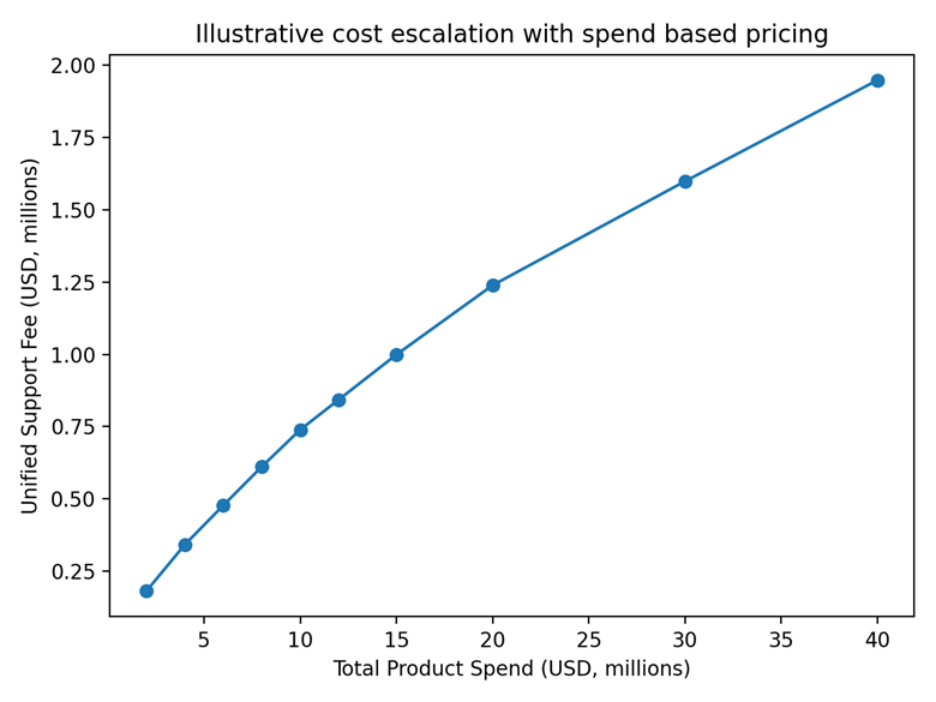
This is an illustration using the published Unified Enterprise rate table and a simple spend mix assumption. It shows the structural point: spend drives fee. If your organization is scaling Azure, Dynamics 365 or Microsoft 365 usage, you should expect Unified Support fees to rise unless offset by negotiation, scope changes or both.
2. The Entitlement Illusion: Coverage is Broad, ROI Data is Thin
Unified Support is marketed as comprehensive coverage across your Microsoft portfolio, including reactive support and a catalog of enablement services. Microsoft describes the service components here.
Procurement often hears "everything is covered" and assumes that coverage translates into measurable value. The problem is not that the entitlements exist. The problem is that many of the benefits are difficult to quantify, difficult to consume at scale or both, especially when internal teams are already overloaded.
ISG frames the pricing model as effectively a spend linked "tax" and argues that the model lacks transparency and relevance across the products it purports to cover. ISG analysis.
"Its pricing model is effectively a 'tax' on customers' product and service spend." ISG..
3. Renewal Creep: When Usage is Flat but Spend Climbs
The easiest way to explain renewal creep to stakeholders is to show cost per incident. If ticket volume stays steady, spend-based support makes each ticket more expensive over time.
Figure 2 uses the same illustrative model as Figure 1 and assumes 200 tickets per year. Your numbers will differ, but the direction is the point.
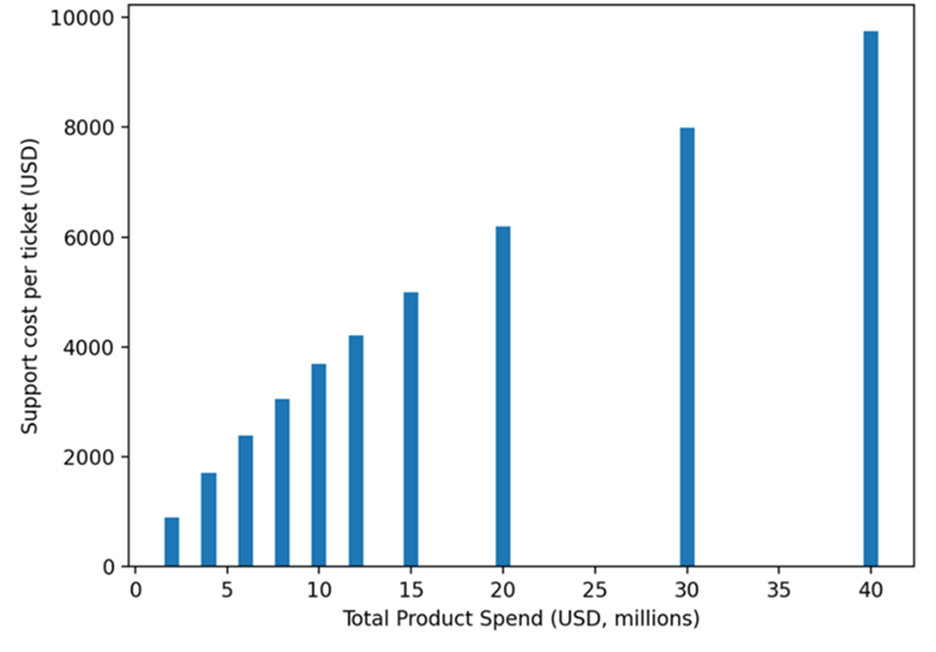
Even if your environment is stable, cloud adoption often grows. That means support costs rise even when the operational workload does not. This is why many procurement teams struggle to defend Unified Support ROI at renewal: the invoice is climbing while the internal perception of value is not.
4. The true cost that procurement teams may miss when reviewing Unified invoices.
Unified Support fees are only one part of the economics. The larger cost is the downstream impact of extended incidents and drawn-out remediation cycles.
IDC research cited by AppDynamics reported an average hourly cost of infrastructure failure of $100,000 and critical application failures of $500,000 to $1 million per hour. AppDynamics summary of IDC survey.
Atlassian also notes that downtime costs vary widely and references that Fortune 1,000 companies can see downtime costs as high as $1 million per hour based on an IDC survey. Atlassian cost of downtime.
This is why procurement should treat support models as risk management contracts, not just a line item. When you cannot connect support spend to reduced downtime, reduced recurrence and faster recovery, you are negotiating blind.
5. The ROI Breakdown Procurement Cannot Currently Access
If your renewal team had a clean ledger of support consumption, the Unified model would be easier to evaluate. In practice, most buying teams (procurement, sourcing, purchasing, finance and IT) can’t answer basic consumption questions in the renewal meeting, including:
• How many incidents were opened by product area and by severity
• Median time to a qualified engineer for Sev A and Sev B cases
• Median time to mitigation, time to resolution and recurrence rate for top incident types
• Total engineering hours spent by Microsoft support teams per case category, including escalations
• The portion of proactive entitlements consumed, who consumed them and what outcomes they produced
This lack of actionable consumption data creates a renewal visibility gap. It makes ROI hard to prove and it makes rightsizing almost impossible.
6. Incentives Built into the Model
The Unified design is not mysterious. It links support fees to the same growth drivers Microsoft is already selling: cloud usage, subscriptions and enterprise licensing. ISG argues that this redesign was driven by revenue growth potential rather than a broken Premier model. ISG discussion.
That is why teams evaluating options often experiences a mismatch: you can grow Microsoft adoption while successfully reducing incident volume through better engineering practices but Unified still grows because spend grows.
7. What Partner Led Support Corrects Immediately
A partner led model such as DCG Advanced Support changes the equation by tying cost to engineering effort and measurable delivery, not to licensing volume.
DCG positions its model around predictable, needs based pricing aligned to engineering work plus stronger transparency through usage logs and governance reporting. DCG Advanced Support Procurement Hub.
To make the best buying decision for their organization, contracting teams should focus on:
• Usage based cost: you pay for delivered engineering work, not for hypothetical entitlements
• Transparency: monthly logs that show hours, case categories and outcomes you can defend in finance reviews
• Flexibility: the ability to right size as demand changes, instead of locking in annual uplift

8. Procurement Comparison Table: Unified vs DCG
This table reflects the procurement framing on DCG's Procurement Hub and maps it to common renewal decision criteria.
9. Evaluation Checklist: What Procurement Should Request Before Renewal
Before signing another Unified renewal, ask for the data that makes ROI measurable.
Use these questions as your baseline.

.png)