

What Microsoft's EA Changes Mean for the Teams That Run the Environment
This is a briefing for IT, covering what's actually changing operationally, what isn't, and five questions to have ready before any transition conversation starts.
IT didn't sign the Enterprise Agreement. The purchasing team did, years ago, in a negotiation which IT was rarely part of. Every license provisioned this week, every ticket escalated; every new hire seat assigned, runs through the commercial structure that agreement put in place. When that structure changes, IT absorbs the operational consequences. Nobody has to frame the conversation as an IT conversation for that to be true.
That's exactly what is happening right now. Microsoft is restructuring the Enterprise Agreement, and most of what's been written about it targets Procurement and Finance: discount tiers, renewal pricing, contract language. Underneath those commercial headlines sits an operational story nobody has handed IT directly: who your team calls when something breaks, whether the admin center still works the way it did last quarter, and how much of the coordination gap lands on your desk by default. That's what this post covers.
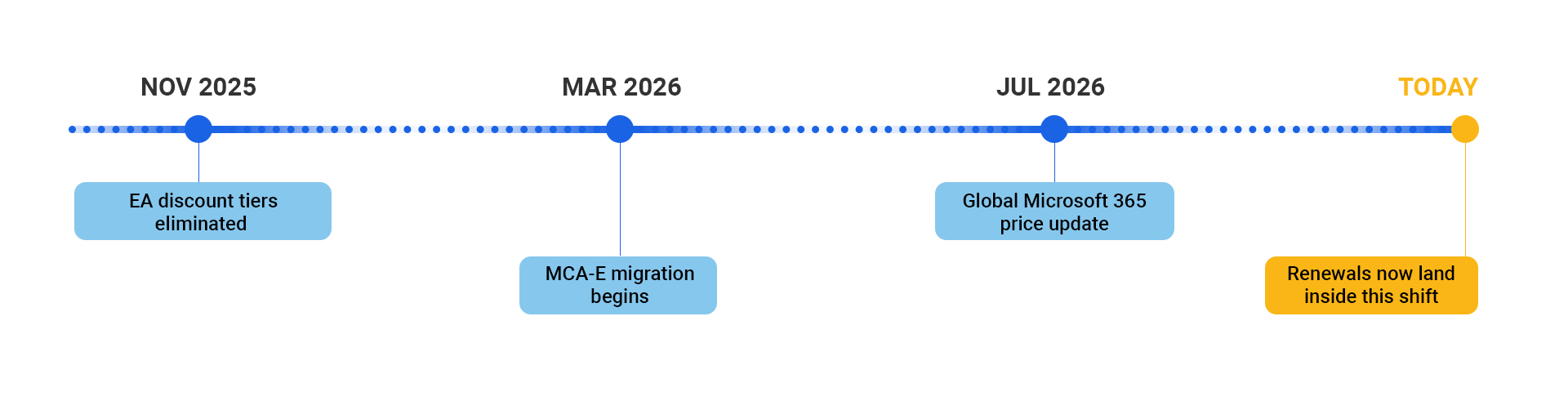
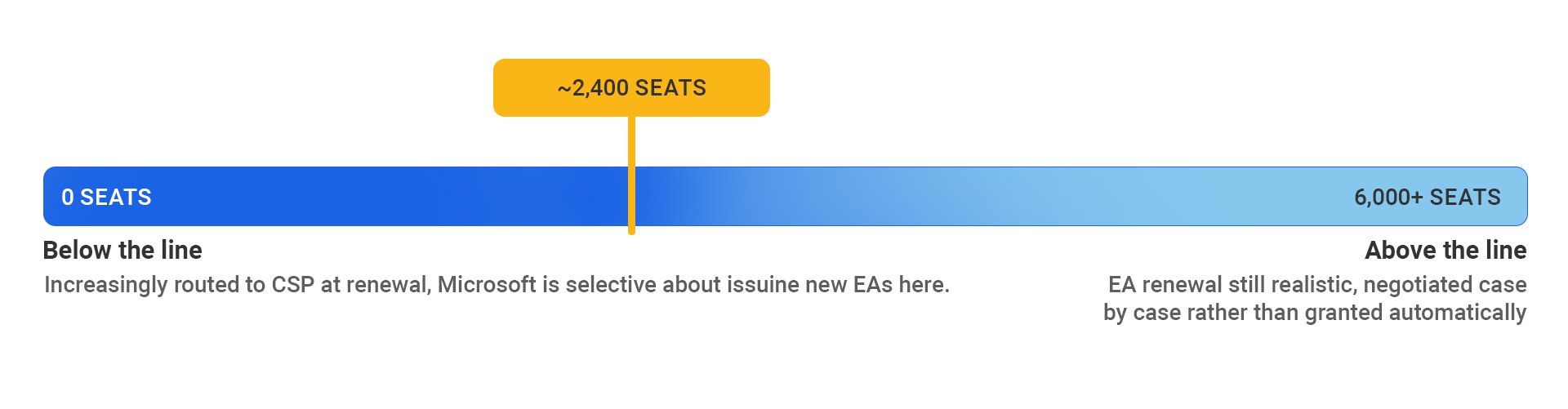
Your organization still runs on the same products. What's shifting is who's accountable for the relationship around them. Here's where that actually shows up.
1. The account manager you used to escalate to is stepping back
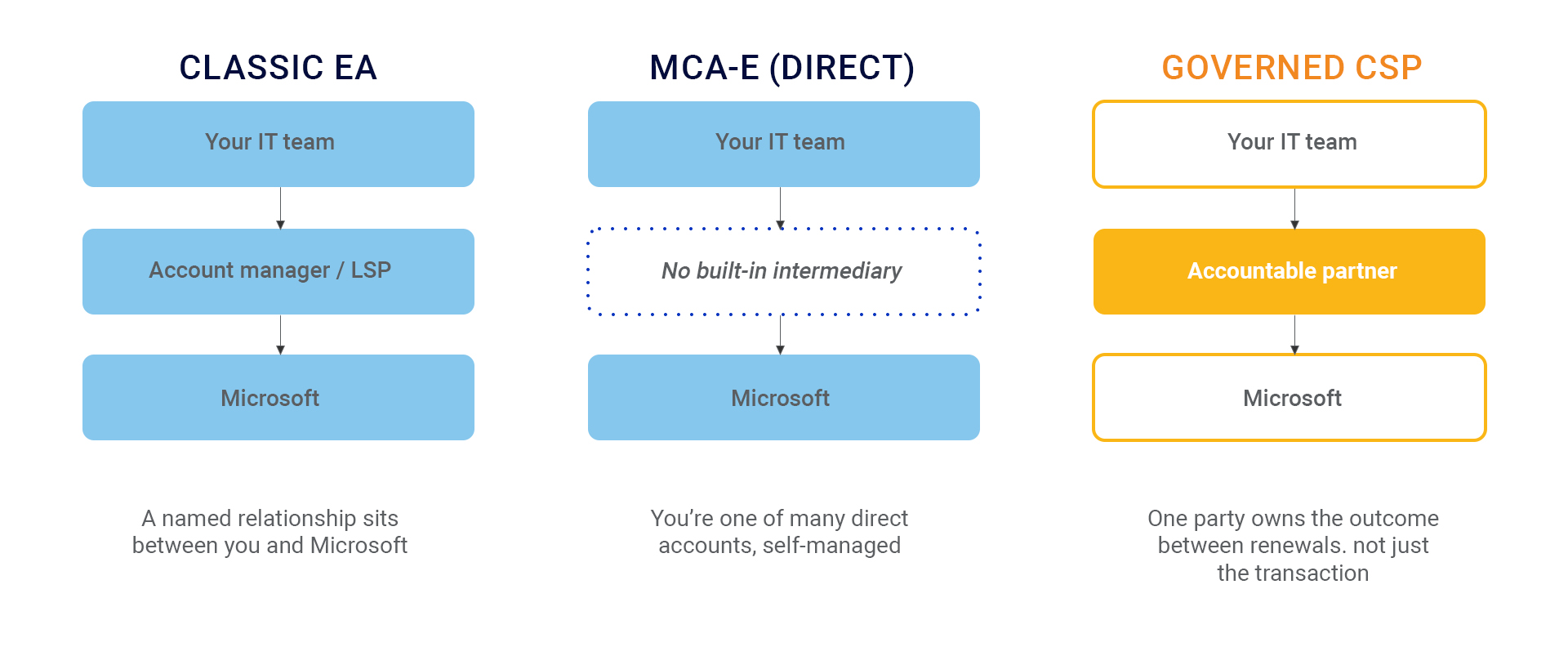
Under a traditional Enterprise Agreement, a Microsoft account manager, or the Licensing Solution Provider (LSP) managing your EA, served as a standing point of contact: someone who already knew your environment, could triage a licensing question, and had context on your last few renewals. Microsoft's own guidance for organizations moving onto a direct Microsoft Customer Agreement (MCA-E) confirms that structural change: the relationship connects your organization directly to Microsoft or to a partner you select, without a Licensing Solution Provider built into the agreement the way there was under a classic EA. Independent licensing analysts have described the broader pattern plainly: Microsoft consolidating its largest accounts under direct management while routing everyone else toward the CSP channel.
For IT, the practical effect isn't dramatic, but it's real. The informal escalation path, the person who already understood your tenant, your history, and your quirks, isn't guaranteed to exist anymore. You become one of many direct accounts, or the relationship gets picked up by whichever CSP partner won the business. Either way, someone new is learning your environment from scratch, right when you need them to already know it.
2. What doesn't change: provisioning and license assignment
This part is worth stating plainly, because it's easy to assume otherwise: how licenses get provisioned and assigned inside your tenant does not change under this shift. Microsoft's own admin documentation confirms that license assignment for CSP-purchased subscriptions runs through the same Microsoft 365 admin center your team already uses, with the same Billing > Licenses screen and the same License Administrator role controlling who can make changes. The commercial vehicle behind your licenses is changing. The console your admins open every day stays the same.
That distinction is easy to lose between Purchasing teams' contract conversation and your team's daily reality. The purchasing team is negotiating an agreement. Your admins are opening the same console they opened yesterday. Keeping those two facts separate is what keeps this transition from feeling bigger than it actually is, operationally.
3. The overhead that's real: coordination without an owner
The genuine operational risk sits between those two facts. When account management moves back to Microsoft, and the partner behind your CSP licenses treats the relationship as a transaction rather than a governed handoff, the coordination gap doesn't go away. It just loses its owner. Billing questions, license right-sizing, and escalation routing still have to happen. Without a defined point of accountability, your team ends up absorbing that work by default, one ticket at a time. Getting precise about who owns that gap, early, is what keeps your team from closing it under pressure later.
The Risk Is Foreseeable, Which Means It's Manageable
The commercial side of this shift is real, and it isn't reversing. Microsoft has been consistent with the direction of travel. But the operational risk underneath it is manageable, because it's foreseeable. IT doesn't have to inherit that coordination gap by default. Closing it is exactly what a governed partner relationship is for.
DCG governs the Microsoft environment end-to-end: licensing, provisioning, and the escalation path between, so the questions above have an answer before they turn into a ticket.
RELATED FROM DCG

.png)