


Before You Blame the System: 6 Clues Your ERP Misunderstands Finance Workflows
It’s the home stretch. Your finance team is staring at another month-end closure that’s become a marathon of workarounds. Reports are delayed, audit trails are messy, and approvals have shifted from structured workflows to never-ending email chains. When an ERP system underperforms, it’s easy to assume the software itself is to blame. However, the root cause often lies deeper, embedded in the initial assumptions and decisions made long before the system went live.
Before you blame the software, ask yourself: Did we ever truly build this system for finance operations?
This haunts more CFOs and finance leaders than you might think. In fact, a study by BlackLine, Inc. found that nearly 40% of CFOs globally admit they don’t trust the accuracy of their organization’s financial data. This highlights the need for finance systems to be designed with finance teams in mind. Responding to unexpected market disruptions also becomes difficult due to uncertainty in cash flow visibility. At DCG, we’ve seen it firsthand: ERP systems that were sold as silver bullets but implemented in a cookie-cutter fashion. The system may have been shiny on the surface, but it was painfully misaligned beneath.
Many ERP journeys start with a handshake and a promise, yet skip the hard conversations:
- Did your implementation partner truly understand finance’s role in your business?
- Did they map the workflows that keep your financial house in order—approvals, reconciliations, compliance?
- Did they bring in an off-the-shelf approach, assuming finance would just “figure it out” once the system was live?
Here’s the truth: Selecting a solution and a partner without proper diligence is a recipe for failure to deliver on the vision.
ERP failure often doesn’t come from the system itself but from the shortcuts taken during the critical discovery phase. By excluding finance leaders, the system now reflects someone else’s idea of how finance should work, rather than how it actually operates.
Explore the SPEAR Framework to learn how every step can be tied to your implementation strategy for a holistic experience.
The Illusion of a "One-Size-Fits-All"
Several organizations embark on ERP implementations with the belief that the chosen system will seamlessly integrate with their existing processes. As highlighted in "Before Your Implementation Fails: Early Warning Signs Your ERP Project Needs a Reset," failing to align the ERP system with the organization's unique workflows can lead to significant disruptions. Overlooking your finance team’s workflow nuances during the implementation phase can result in a system that is technically operational but fails to serve its intended purpose. At DCG, we refer to this as a workflow mismatch, and it’s one of the biggest culprits behind underperforming ERP investments.
Approval Process Feels Like a Maze
Though generic approval hierarchies look clean on a PowerPoint slide, finance teams rarely work in straight lines. Delegations of authority, exception handling, and compliance thresholds often get oversimplified or overlooked during implementation.
When you see your team resorting to emails and spreadsheets to bypass system bottlenecks, it’s evidence that your ERP vendor didn’t take the time to map your finance reality into the system.
DCG Insight: True ERP success starts with immersive finance process mapping, ensuring every approval reflects the controls, thresholds, and exceptions that matter most.
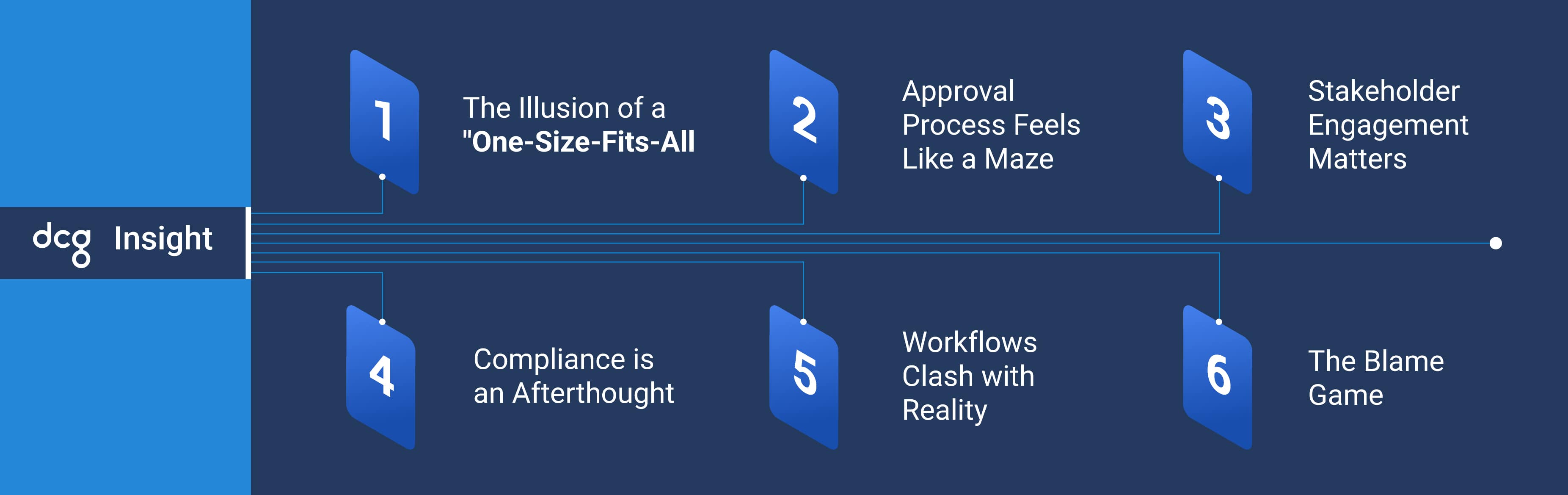
Stakeholder Engagement Matters
A persisting theme in ERP failures is the inadequate involvement of key stakeholders (C-suite, VPs, project managers). Miscommunication during the requirements gathering phase often leads to misalignment between stakeholder expectations and system capabilities. Our SPEAR methodology mitigates this risk by structuring the transformation journey through an ERP Readiness Assessment, forcing honest conversations between decision-makers and operators at every step. By engaging finance leaders early and often, SPEAR ensures all priorities are integrated, reducing the risk of post-implementation dissatisfaction.
Compliance Isn’t Optional – It's Fundamental
In finance, compliance isn’t optional. Yet most ERP implementations treat compliance as a feature to add later, rather than a non-negotiable pillar of system design. If your audit trails are incomplete or your team uses manual logs to track approvals, it’s a liability. We integrate compliance into every step of our project methodology, ensuring that financial integrity is built into your workflows, not added as an afterthought.
Workflows Clash with Reality
Finance workflows are the backbone of financial control: journal entries, reconciliations, and period closes. Most ERP implementations are guided by surface-level demos and generic templates. The result? Finance workflows that might work somewhere, but not in your organization. Our approach prioritizes buy-in from every team involved to capture your real processes. The result ensures a system that aligns with the way your people work.
The Blame Game
When systems underperform, finger-pointing begins: IT blames finance, finance blames project managers, and consultants blame everyone else. But the root cause often lies in rushed implementation. The “solution” was one that failed to bridge the gap between technology and finance’s unique workflows. These systems become barriers rather than enablers. And no number of technical patches or fancy dashboards can compensate for a system that doesn’t fit the business it’s supposed to serve.
At DCG, we own the business side of ERP rescue, not just the technology. Our SPEAR methodology prioritizes accountability and partnership.
Bottom Line: It’s Time to Challenge the Assumptions
If any of these red flags sound familiar, it’s time to look beyond the system itself and ask the harder question: Was the implementation truly finance-driven?
ERP failures often start with the wrong partner, a superficial understanding of finance processes, and a rush to “go live.” DCG specializes in rescuing ERP investments by re-engineering workflows, aligning technology with finance reality, and delivering the business results you expected all along.