

Why Your Support Vendor Can’t Keep Up with Azure
Support vendors fall behind Azure because Microsoft ships change faster than a pooled or generalist staffing model can track. In July 2026, a routine month with no Microsoft conference driving extra announcements, Microsoft’s own Azure Updates feed logged fifty-seven separate general availability launches, previews, feature changes, and retirements. That is close to two updates a day on a platform most enterprises now run mission-critical workloads on.
How Often Does Azure Actually Update?
There's no fixed release schedule to wait on. New compute options, AI tooling, and security controls land in a subscription the moment they're ready, not on a platform refresh cycle. Coordinating updates across two hundred-plus services every week, without breaking what’s already running in production, is a genuine engineering achievement.
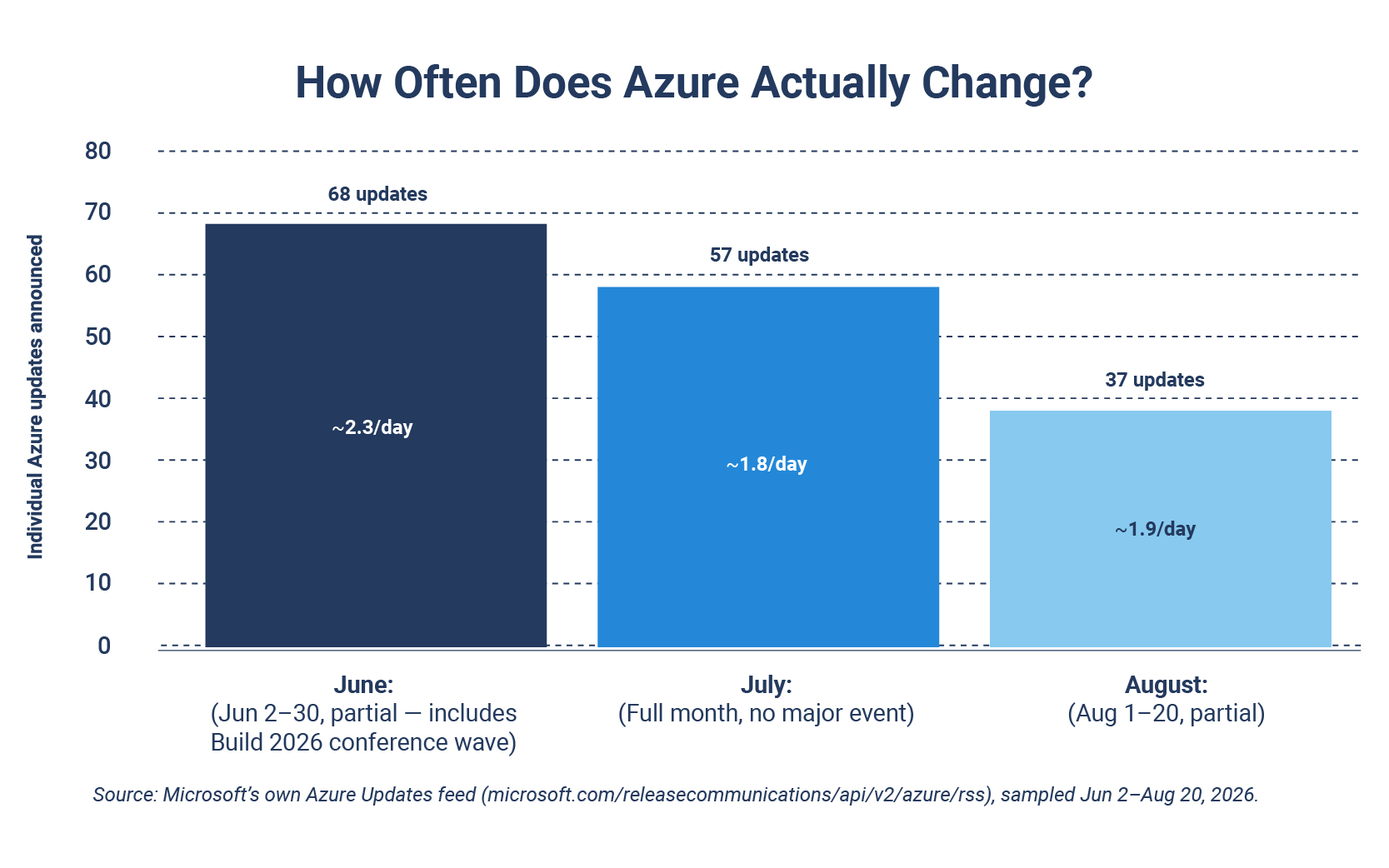
That engineering pace shows up clearly in the numbers above: June, July, and August 2026, counted directly from Microsoft’s release feed rather than estimated. Even outside a keynote moment like Microsoft Build, the pace doesn’t let up: annualized at July’s steady rate, with no conference behind it, Azure moves at somewhere north of six hundred and fifty updates a year. A vendor’s engineers face roughly two new changes a day, all year, not a handful of headline announcements twice a year at Build and Ignite. Azure’s pace of change also creates a workforce problem.
Why the Pace Itself Creates a Staffing Problem
Keeping one engineer current on two hundred services that each change weekly is unrealistic. Large support organizations solve that the way large organizations solve most coverage problems: they pool engineers and average expertise across the team. Pooling works fine when the underlying platform stays still. It works less well when the platform is moving fast.
A pooled or generalist engineer pool carries an average level of currency. Nothing guarantees that the engineer who picks up a case is current on the exact service or the exact recent change driving the issue. That gap rarely shows up in a quarterly business review. It shows up on a Tuesday afternoon, in the middle of a ticket.
Imagine that Tuesday afternoon ticket scenario: a workload that started misbehaving after Microsoft quietly changed default behavior on a service three weeks earlier. The engineer assigned to the ticket learned that service a year ago and hasn’t had a reason to revisit it since. The first hour of the case goes to ruling out the engineer’s outdated mental model of how the service works, one wrong theory at a time, before anyone reaches the real problem. This scenario is worth walking through because it never appears on a vendor’s capability slide. It only shows up in the ticket history the client already has.
What the Gap Looks Like on Your Next Ticket
The ticket above isn’t a one-off. Three things happened on that ticket, and each one only tells part of the story on its own:
The release cadence reality: Azure changed again this week, and will likely change again next week, faster than most engineers can independently verify on their own time.
The familiarity gap: the assigned engineer’s knowledge reflects an average level of familiarity with Azure, not certainty about the specific service or change this case depends on.
The hidden cost: the ticket can take longer to close because the engineer is troubleshooting from an assumption about how the service behaves, an assumption that was accurate eight months ago and stopped being accurate the day Microsoft shipped the change.
Read on their own, these three things look like a busy changelog, a workforce statistic, and one slow ticket. Read together, they point to the same open question: who is verifying that the person on your case is current, and how often?
Two staffing philosophies answer that question in very different ways:
Only one of those two models can promise that the person working on your next ticket is caught up on the service in question.
Specialization Built to Stay Current
That promise is the whole premise behind DCG’s Enterprise Support model: engineers work inside the Microsoft ecosystem exclusively, with their knowledge of each service tracked and renewed continuously as Azure changes. The full model is outlined on DCG’s Enterprise Support.
Continuous specialization matters more now than it did two years ago, because the ecosystem it covers is accelerating. The fastest-moving part of Azure right now is the part enterprises are watching most closely: Foundry, Copilot, and the wave of native agent tooling shipping into the platform almost weekly. A certification earned eighteen months ago says little about whether an engineer understands what changed in Azure AI Foundry last month.
That acceleration is exactly what raises the question worth asking about any vendor already under contract: was their staffing model built to track a platform that changes this often, or just to look staffed for the average case?
Answering that question takes about fifteen minutes: run your own environment through DCG’s Unified Alternative Calculator, a short self-serve assessment that compares your current ticket patterns against Microsoft Unified Support’s pooled coverage model and surfaces exactly where a continuous-specialization model closes the gap. Worth doing before the next renewal conversation rather than during it.

.png)